

AIoT, or the Artificial Intelligence of Things, is fundamentally reshaping industries and quietly becoming “the silent architect behind smarter, more responsive ecosystems.” Where earlier IoT leaned on cloud processing, AIoT shifts inferencing to the edge—on devices, gateways, and chipsets—elevating after-the-fact analytics into real-time, on-device intelligence.
The shift is so pervasive that experts anticipate nearly every future IoT solution will carry some flavor of AI. The numbers back this up—the global AIoT market, valued at USD 171.4 billion in 2024, is projected to skyrocket to USD 896.7 billion by 2030, growing at an impressive CAGR of 31.7% as estimated by Grand View Research.
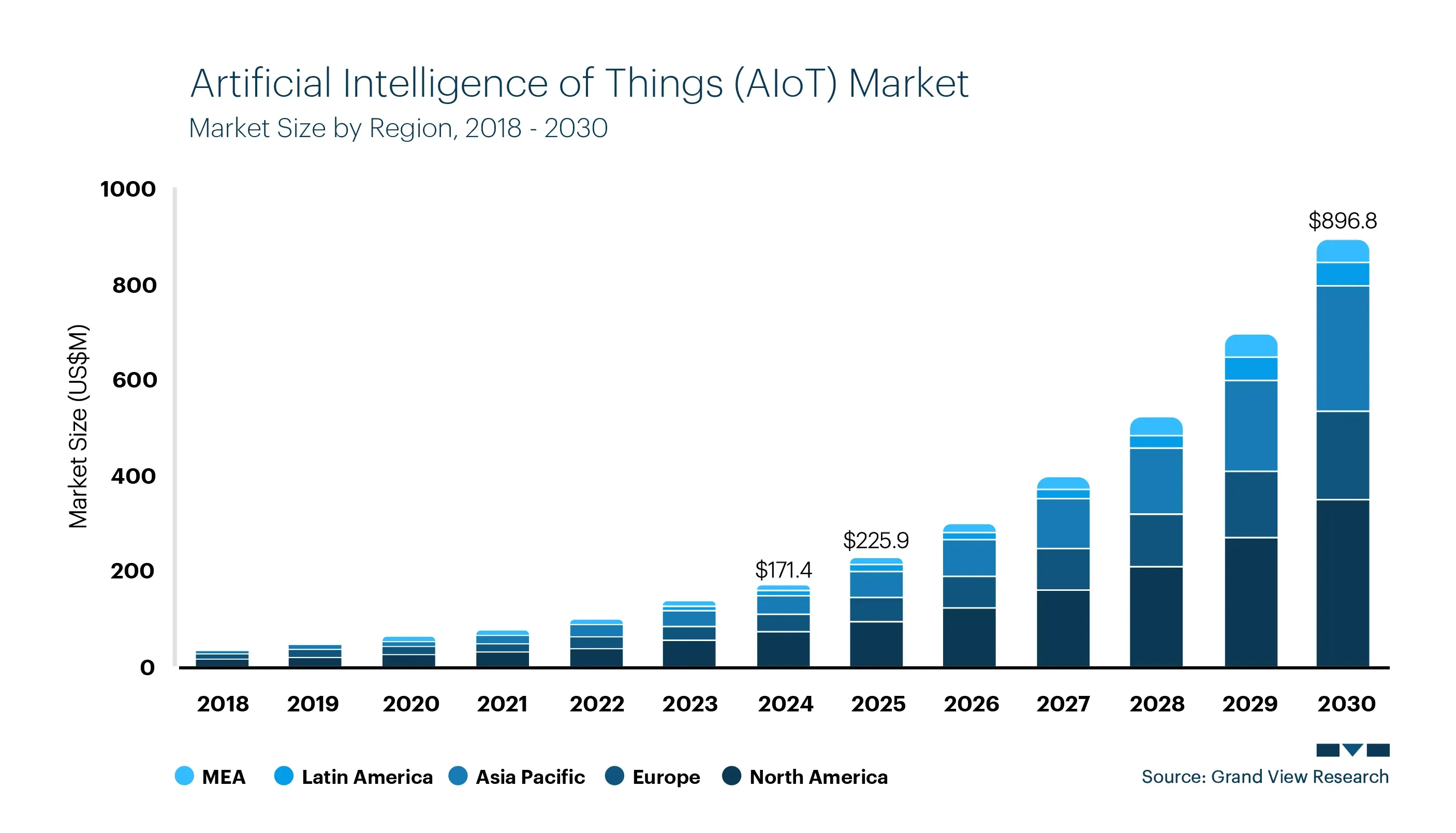
This is more than an incremental upgrade—it’s a paradigm shift unlocking immense value: optimizing operational performance, enabling higher levels of automation, and delivering intelligence and efficiency across diverse sectors. For organizations navigating the complexities of digital transformation, understanding AIoT’s core mechanics, market drivers, current applications, and future potential is no longer optional—it’s critical for staying competitive in a hyper-connected, data-driven world.
What is AIoT?
AIoT represents the powerful convergence of Artificial Intelligence and the Internet of Things. At its core, it is simply AI plus IoT—a combination that has existed for years. Historically, IoT devices collected data and sent it to the cloud, where AI handled inference and post-data analytics. The real breakthrough over the past five years has been the shift from cloud-only to edge execution—on devices, gateways, modules, and even at the chipset level—bringing intelligence closer to where data is generated.
As organizations evolve through this shift, clarity and communication become critical. Charles Anderson, noted Tech Strategist & Keynote Speaker, reinforces the need for clarity across teams, reminding us, “You can't leave this kind of technology to just the technology people. If you can't explain it to the guy who's not technical, you're not going to go anywhere.”
This shift to edge AI is so fundamental that within the industry, AIoT is often understood as edge intelligence by default, even if the word “edge” is not explicitly stated. By embedding AI closer to where data is generated, AIoT moves beyond simple connectivity and data collection, enabling devices to learn, reason, and act independently in real time.
This integration transforms raw data streams into actionable intelligence, fostering systems that are not only smarter but also continuously optimizing and anticipating future needs. AIoT drives a shift from reactive to proactive operations across industries—supporting real-time decision-making, anticipatory responses, and the creation of interconnected ecosystems that think, learn, and adapt without human intervention.
Vision Intelligence and Core Components of AIoT
AI-powered vision intelligence is transforming how connected systems perceive and act. By combining visual data with machine learning, industries are deploying intelligent cameras and embedded processors that detect anomalies, monitor safety, and automate decisions in real time—all while reducing cloud dependence and ensuring data privacy. Running compact, optimized models on edge devices delivers millisecond response and efficient bandwidth use, making visual analytics viable even in constrained environments.
For organizations architecting AIoT systems, a major strategic consideration is how much to build internally versus leveraging existing ecosystems. As Satyajit Sinha, Principal Analyst at IoT Analytics, frames it, “we have to decide whether to build everything ourselves or leverage what others have already created.”
Built for reliability across varied conditions, these vision systems demonstrate how perception itself is becoming a core computing layer within AIoT. Building on this foundation, the core components of AIoT—sensors, analytics, connectivity, AI algorithms, and computing infrastructure—work together to bring intelligence closer to data creation points. Vision acts as the sensory front end, analytics and AI algorithms form the decision layer, connectivity links the ecosystem, and computing infrastructure supports scalable orchestration. Together, they form the operational core of AIoT systems that learn, adapt, and optimize in real time.
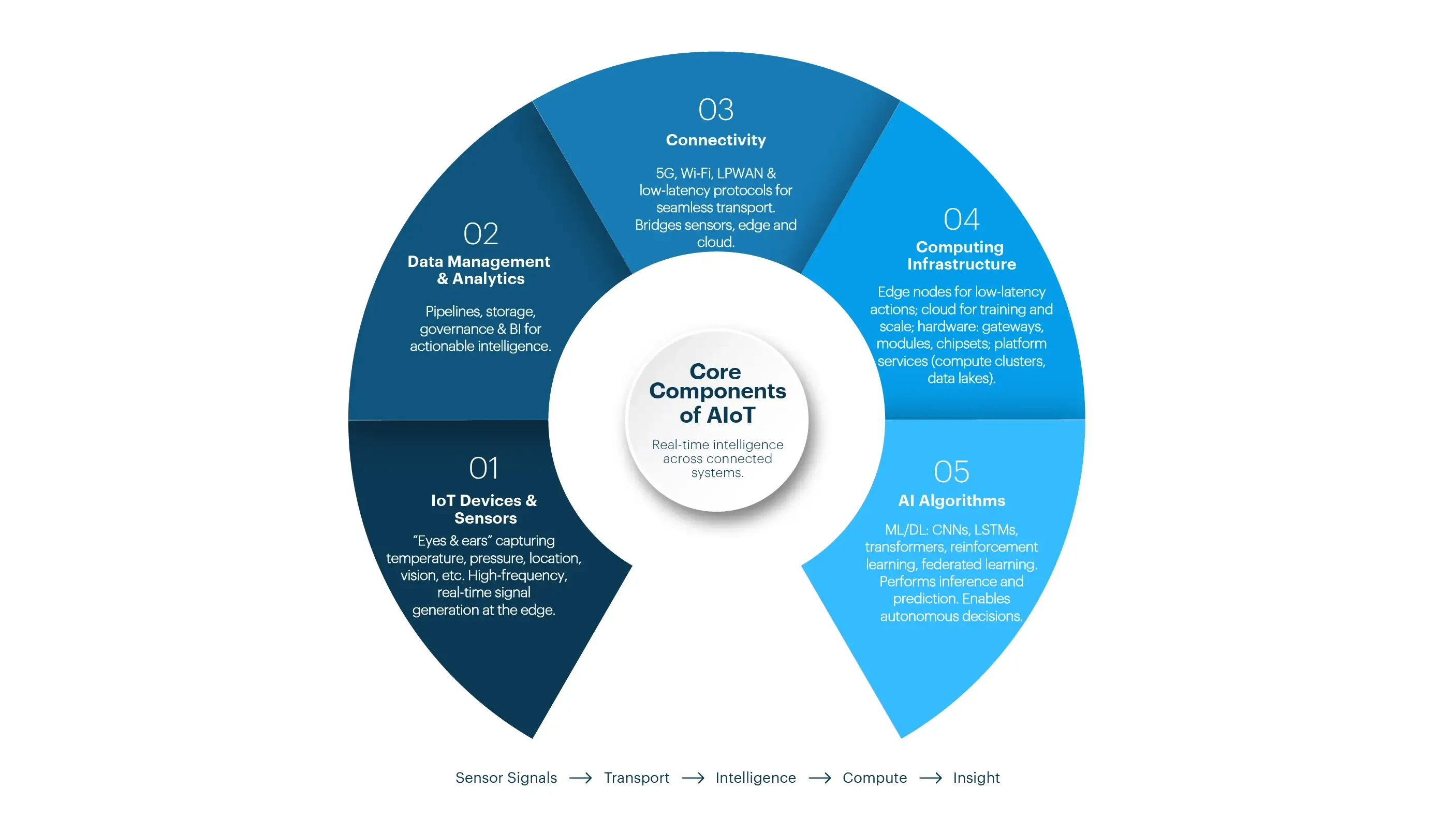
Core Components of AIOT
Market Scale & Growth Dynamics
The AIoT market is entering a phase of accelerated maturity. According to Counterpoint Research, by 2030, nearly one in five IoT devices will feature embedded AI capabilities—marking a transition from passive data collection to active, autonomous decision-making. This evolution is less about incremental innovation and more about redefining the core value proposition of IoT—from connectivity to cognition.
AI integration is rapidly becoming a default expectation across verticals. From predictive maintenance in manufacturing to personalized energy management in smart homes, embedded intelligence is driving tangible business outcomes: reduced latency, improved energy efficiency, and localized decision-making. The result is an ecosystem that’s smarter, leaner, and contextually aware.
As industry expert Subhadip Roy, IoT Component Ecosystem Analyst at Counterpoint Market Research, notes:
“We are seeing the rise of modem-centric and chipset-centric AI. Companies like Qualcomm are embedding AI engines directly into their modems—not for apps, but for network-level intelligence.”
This marks a foundational change, making connectivity itself smarter and laying the groundwork for AIoT systems that learn, adapt, and optimize from the inside out. Instead of treating AI as a software layer added later, leading semiconductor firms are integrating intelligence at the silicon and network levels—enabling real-time inference and adaptive communication within the device fabric itself.
Cloud providers are complementing on-device intelligence with AIoT-ready infrastructure, ensuring scalability without latency trade-offs. Together, hardware, connectivity, and intelligence now form a unified foundation for real-time, autonomous systems—shaped by the ecosystem players below.
Key Players and Strategic Positions
| Player / Group | Core Strength / Focus | Role in the AIoT Stack | Strategic Moves / Notes |
|---|---|---|---|
| Qualcomm | Wireless, embedded compute, large device scale | Edge compute + connectivity + integration | Acquiring Edge Impulse to bring AI model tooling in-house and strengthen software + hardware integration; announced plans to acquire Arduino to deepen developer community reach |
| Nvidia | GPU & AI acceleration, vision pipelines, AI ecosystem | Edge inference + orchestration + vision support | Known for Jetson modules and AI tooling stack, pushing hybrid architectures (CPU + GPU) in embedded AI systems |
| MediaTek | Power-efficient SoCs, IoT, and mobile legacy | Mid-tier AIoT nodes | Actively developing its Genio series and aligning with AIoT device requirements |
| Intel / Movidius | Edge vision and accelerator silicon | Compute + vision subsystems | Recognized in the industry for vision acceleration, evolving toward intelligent edge architectures |
| Arm | Processor IP, architecture ubiquity | Foundational design + enabling ecosystem | Holds widespread licensing in IoT; increasingly integrating neural-processing capabilities and AI support in architecture roadmaps |
| Cloud / Platform Providers (AWS, Azure, Google, IBM, Cisco, etc.) | Orchestration, AI pipelines, data services | Platform + middleware + cloud-edge interconnect | Building AIoT capabilities into their stacks to own end-to-end AIoT flows and lock in data/control layers |
As companies move deeper into AIoT adoption, people readiness becomes as important as technology readiness. Abhishek Anand, Founder & CEO of Skill Bud Innovation Studio, highlights, “organizations often overlook the role of team preparedness in successful AI adoption. Exposure and education make the journey far smoother by enabling teams to internalize AIoT transformations.” At the same time, because industries differ significantly in how value is measured, Avrohom Gottheil, renowned tech influencer and thought leader, emphasizes the importance of tailoring KPIs to each industry to ensure results that truly matter.
As these players shape the AIoT ecosystem, cross-functional alignment becomes a critical success factor for enterprises. This is why, as Charles Anderson notes, success metrics must be set up front and agreed upon by different stakeholders. Aligning business, IT, and operational leaders on common goals ensures that every team measures progress through the same lens.
Edge, Cloud, or Hybrid: Where Is AIoT Headed?
AIoT’s growth isn’t driven by a single breakthrough—it’s powered by pragmatic decisions around cost, capability, and context. As organizations evolve from pilots to scaled deployments, architecture choices - edge, cloud, or hybrid - are shaped less by trends and more by return on investment.
The Business Case Behind the Architecture
Every AIoT initiative begins with economics. Gopinath Krishnamurthy, Vice President of EMEA Sales & Business Development at Cavli Wireless, warns against mistaking ambition for feasibility:
“There is too much hype around AI capabilities. IoT devices and solutions are cost-sensitive. There is a price premium to be paid for such initiatives, and the business case and customer application must justify the usability of higher-spec processors for such Edge AI in IoT applications.”
That practicality drives architectural decisions. Satyajit Sinha frames it as an ROI equation—balancing recurring cloud costs against capital investments in edge hardware. “For a project with a million devices, the economics of the cloud might make sense. But for a housing complex wanting local data control, an edge setup is the logical choice.” Financial rigor is another pillar; he underscores balancing capital expenditure on edge devices with the ongoing operational costs of cloud infrastructure.
The Architectural Tug-of-War
Once the business logic is set, three factors - latency, privacy, and scale - define the technical direction.
The cloud still attracts early adopters. As Kreiner Andreas, Technologist & Strategist at Nimble Innovation, notes, “many organizations go for cloud first due to hyperscaler incentives and ease of access. The cloud excels in scalability, model training, and data centralization, reducing the complexity of hardware management.”
But the cloud isn’t universal. For critical applications where milliseconds matter, Abhishek Anand emphasizes that edge computing is vital in environments where latency or privacy is non-negotiable - like operating rooms or manufacturing lines. In such scenarios, the edge ensures instant response and data sovereignty.
The Hybrid Reality
Between cost pressures and performance demands, most experts now converge on a hybrid future. Avrohom Gottheil captures this shift succinctly:
“Companies are gravitating towards hybrid edge-cloud solutions. The hybrid model offers a balance of speed and scalability.”
In practice, the edge handles immediate, time-sensitive functions—detecting defects, monitoring vitals—while the cloud manages aggregation, analytics, and model refinement. As Abhishek Anand puts it, organizations increasingly seek the immediacy of edge with the learning depth of cloud.
Market data support this transition. Anish Khajuria, Digital Transformation and IoT Analyst at CounterPoint Research, notes that by 2030, “of all IoT modules that are AI-enabled, 15% will be hybrid AI-capable, compared to 10% that are purely edge-based.” The message is clear: hybrid architectures are becoming the dominant model.
As companies adopt hybrid approaches, customer value becomes a key indicator of success. This aligns with the insight shared by Avrohom Gottheil and Anish Khajaria - “Customer satisfaction remains the most reliable indicator of long-term success. It builds loyalty and fuels continuous product improvement.”
An Evolution, Not a Leap
AIoT maturity unfolds in stages. Charles Anderson observes, “First, you’ve got to get everything in the cloud and working before you can move on to edge processing. Everything’s got its evolution process.” Most organizations begin by centralizing data in the cloud, then gradually shift workloads to the edge as technical confidence grows.
In essence, AIoT adoption mirrors digital maturity. The journey begins with experimentation, matures through hybrid optimization, and culminates in an architecture that balances agility, cost, and intelligence—where edge and cloud coexist to deliver real business outcomes. At the operational level, Anish Khajuria stresses the significance of uptime, latency, and data accuracy as measures of reliability. Optimized AIoT deployments, he adds, can also cut energy consumption by up to 20%, driving both cost efficiency and sustainability.
Which AI Techniques Hold the Most Promise for IoT?
AIoT is advancing rapidly, but a handful of AI techniques stand out as game-changers. They’re redefining how data is processed, decisions are made, and systems learn in real time.
- Federated learning for privacy-first intelligence
Federated learning trains models directly on devices instead of sending raw data to the cloud. This makes it a strong fit for sectors like healthcare, smart homes, and manufacturing, where privacy is critical. As Avrohom Gottheil notes, “it enables intelligence at scale without exposing sensitive information.” - Reinforcement learning for self-optimizing systems
Reinforcement learning allows machines to learn from feedback, adapt, and improve continuously. It’s especially promising for energy management, traffic control, robotics, and autonomous systems—environments where self-optimization is key to performance and safety. - Next-gen architectures: xLSTM and foundation models
Some breakthroughs are pushing IoT beyond today’s limits. “xLSTM beats transformers in their home turf,” says Andreas Kreiner, noting its strength in time-series data like vehicle telemetry. Meanwhile, multimodal foundation models—trained on text, vision, and audio—are unlocking new possibilities in robotics, industrial automation, and adaptive systems.
Key Industries Leveraging AIoT and the Road Ahead
AIoT is finding its strongest footholds where speed, efficiency, and safety can’t be compromised. From cars that can’t wait for the cloud to factories that can’t afford downtime, intelligence at the edge has become a necessity—not an upgrade.
Automotive: The Fast Lane for Edge AI




Few sectors illustrate this urgency better than the automotive sector. Modern vehicles generate terabytes of sensor data every day, demanding instant, on-device decisions. As Andreas Kreiner notes, “Vehicles need to perceive and act fast, and cloud may not be available.” Inferencing inside the vehicle is now standard, powering both safety and smarter in-car experiences.
Industry, Energy & Utilities: Quiet Disruptors




While consumer tech steals the spotlight, AIoT’s biggest gains are happening behind the scenes. Manufacturers use it for predictive maintenance and machine vision; utilities for water and sewage optimization; and energy players for real-time leak detection. Charles Anderson observes, “The real action is in the energy and utility space. How do you leverage sensor data to improve sewage system management or water management? That’s where I see a lot of interesting tenders happening right now.” The focus is shifting from showing what sensors can do to proving what savings and outcomes they deliver.
Healthcare & Infrastructure: Human-Centric AIoT




In healthcare, AIoT enables proactive, predictive care. Hospitals are deploying intelligent devices to detect anomalies and prevent equipment failures before they happen. Healthcare will witness the most human-centric impact—AIoT moving from reactive to proactive care. As Abhishek Anand explains, this marks a shift toward proactive healthcare systems. He also adds, “We’re seeing AIoT drive remarkable improvements - from remote diagnostics and predictive device maintenance to real-time patient monitoring in ICUs.” Cities are evolving in parallel, transforming “smart” infrastructure into adaptive systems - traffic lights that learn, grids that self-balance, and surveillance that enhances safety without adding friction.
Retail, Agriculture & Defense: Expanding the Frontier



AIoT’s reach extends beyond the industrial core. While retail is adopting smart shelves and real-time inventory tracking, agriculture is leveraging connected sensors for precision farming - optimizing irrigation, detecting crop issues early, and improving yields sustainably. In defence, AIoT is pivoting from traditional connected kits to adaptive systems shaped by contested battlefields where electronic warfare is constant. Swarm intelligence on nimble ARM-based edge processors lets small UAV fleets coordinate locally, outmaneuver jamming, and sustain missions even when links drop, adds Andreas Kreiner.
The Next Five Years: Toward Autonomous Ecosystems




By 2030, AIoT will evolve from enhancing operations to enabling autonomy. Manufacturing, energy, and urban systems will function like living networks—factories that self-optimize, grids that anticipate demand, and cities that run in harmony. Avrohom Gottheil envisions self-running factories with almost zero human involvement, while Charles Anderson highlights energy and utilities as front-runners, especially in capital-intensive regions like the Middle East. Smarter, data-driven infrastructure will not just drive profits but also sustainability.
Beyond these immediate gains lies AIoT’s most ambitious frontier: intelligent robotics. Satyajit Sinha points out, “The AI is much more ready, and robotics is not capable of adopting those AI.” The next few years will bridge that gap—bringing machines that can truly act, learn, and adapt at the edge. A broader shift is also underway: a renewed emphasis on low-level, highly efficient programming—rather than designing apps on top of huge libraries—signaling how AIoT will diverge from traditional cloud-centric approaches.
The transition to autonomous ecosystems also brings competitive differentiation. Product differentiation also plays a role; as Gopinath Krishnamurthy observes, when AI-powered capabilities like driver monitoring in dashcams enable companies to command premium pricing, that uplift becomes a tangible marker of success. True maturity, he adds, is reflected in scalability — when AIoT systems extend to new use cases or markets without proportionally rising costs, they demonstrate lasting competitive strength.
Cavli CQS315: Bringing Edge Intelligence to Life

Cavli Wireless is at the forefront of the AIoT revolution — redefining how intelligence, connectivity, and performance converge at the edge. Through its next-generation smart modules, Cavli is enabling devices to process, analyze, and act autonomously, transforming industries from automotive to industrial automation.
At the heart of this evolution lies the Cavli CQS315, an LTE Cat 4 smart module built for IoT applications that require intelligent edge computing. Running on the Android/Linux platform, it supports Android Auto and Apple CarPlay, making it ideal for connected infotainment and automotive systems that require real-time responsiveness and intuitive interaction. With up to 1 TOPS of edge processing, the CQS315 empowers applications such as ADAS, driver analytics, and intelligent vision to run locally, ensuring low-latency decision-making and enhanced safety.
Beyond AI, the CQS315 offers unmatched versatility — combining Wi-Fi and Bluetooth for short-range connectivity with LTE Cat 4 and 2G fallback for global coverage. Its Octa-core Kryo 260 CPU and Adreno 610 GPU deliver exceptional multimedia and compute performance, while the Qualcomm Location Suite Gen9VT Engine ensures precise multi-frequency GNSS positioning across GPS, BDS, GLONASS, Galileo, QZSS, and SBAS. With flexible eMMC 5.1 and LPDDR4X memory options, the CQS315 stands as the perfect foundation for building intelligent, AI-driven IoT solutions — bringing true edge intelligence to life.
Author

Aarathy Jayakrishnan
Head of Marketing Operations, Cavli Wireless